Vai al contenuto
TOPICS OF THE MEETINGS
- TARANTO, Violence of Capitalism and Military Colonialism
Introduction to the discussion sessions curated by some comrades from Taranto
Starting from Taranto, an emblematic city of Southern Italy, where the violence of capitalism and military colonialism has irreversibly shaped its economic and social development, we will link how decisions imposed on territories produce a systemic condition in which some areas become more expendable than others, thereby tracing the margins of the Global South.
- Migration routes in the Mediterranean basin, curated by Daniele Ratti
The Mediterranean constitutes the core of the European labor market.
Lacking raw materials compared to other global competitors, the European Community can compete on the global market only on two fronts, innovation and the flexibility of production. Innovation has increasingly become a losing battle in favor of the East, China in particular, so labor flexibility remains the only available tool.
Immigration, of which the Mediterranean basin and the adjacent Balkan route are among the main international hubs, enables the regulation of labor flows and the constant maintenance of wages at minimum levels. This ensures a reserve of labor that is always available, flexible, and low-cost.
This discussion will examine the dimensions of security policies, territorial control and the regulation of productive labor flows according to the specific demands expressed by the market.
- Presentation of the Dossier “Made in Italy. For the Industry of Genocide” curated by the Young Palestinian Youth Movement
“Made in Italy. For the genocide industry” is an investigation documenting Italian complicity in the genocide in Palestine, making it an active part of a global war industry. Since October 2023, a dense network of Italian companies, state-linked entities and logistics infrastructure has delivered at least 416 military shipments and over 224 kilotons of fuel to Israel. The shipments analysed in the investigation involve Italy’s main airports and seaports, the fuel terminals of Taranto and the Bay of Santa Panagia, as well as Italian shipping and airline companies. All of this is contributing to the complete devastation of the Gaza Strip and the ongoing land grabbing, accompanied by hundreds of pogroms and murders in the occupied West Bank. A system aimed at the complete annihilation of the Palestinian population: stopping it is a collective political responsibility.
- Presentation of the book “Revolutions of Our Times”
Collective liberation and grassroots internationalism curated by Les Peuples Veulent
An urgent declaration that advances an internationalism from below focused on people and movements as agents of our collective liberation.
We belong to a single transnational struggle and we stand against an internationally organized elite. We know that if we remain isolated, we will achieve nothing. We have begun to weave a network of planetary connections from front lines to popular assemblies, from feminist strikes to resistance committees, from occupied roundabouts to occupied forests, and have discovered a common sensibility.
“Revolutions of Our Times draws” on the experience of uprisings taking place across the globe over the past two decades and sets out a vision for revolutionary internationalism.
“Although everything has been done to belittle the power of people in revolt, its impact has proved contagious …. Hope, courage, and insurrection have crossed bodies, territories, and all borders.”—from the introduction.
- PRESENTATION OF THE JOURNAL “DISFARE”
Reopening spaces for actions against war curated by some comrades from the editorial team
The war of our century is not confined to the battlefield, it permeates the economy, information systems, infrastructure, logistics, and energy networks. Through modern technology, the organizational logics of military power extend across society as a whole, reducing the world to a resource, a target, a data.
The ubiquity of modern warfare also makes it possible to desert it and jam its mechanisms everywhere, starting from the places we live in. This is especially true in Salento, a borderland and sacrificial territory, a strategic hub for the logistical and energy flows that fuel the war machine, as well as an area for military recruitment and training.
Starting with the first five issues of “Disfare“, an opportunity for collective debate, to break the paralysis and reopen the space for action against war.
- The Dissected Alps: States, Borders, Resistences
Historical overview curated by Tabor Edizioni
Borders are, of course, nothing natural. Their emergence went hand in hand with the long process of building nation-states, between the decline of the Middle Ages and the rise of Modernity. The modern State and the capitalist economy had to supplant every other form of life, imposing their monopolies: over resources – through the privatization of land and common assets -; over time and bodies – through the disciplining of rhythms of life and work -; over knowledge – through the persecution of “witches” and “heretics” and the imposition of “scientific reason” -; over force – through the militarization and disarmament of society -; and over space – through the colonization and fragmentation of bioregions and communities -.
None of this occurred through a peaceful and linear process of progress; on the contrary, it was built upon the defeats of those who resisted and fought before us, as in the “Great Peasants’ War” 500 years ago. Beginning from the Alps—also a bioregion fragmented by artificial borders—this is a long-term perspective on the centuries-old and still unfinished war between autonomy and authority.
- Resistance and Struggles along Poland – Belarus Border
curated by Bez Collective
Bez Collective is a grassroots group that has been supporting migrants at the Poland-Belarus border since late 2021. Through the lens of nearly five years of our work and the constantly changing situation, we would like to talk not only about what we do but, above all, about the brutalization of public life and the progressive restriction of the right to freedom of movement in Europe. This will not be an expertise-based presentation, but rather a sharing of perspectives from those working directly on the field and an opportunity for collective reflection.
- DI TERRA E DI CHI LA LAVORA
Stories of the exploitation of labor and land. A view from the Global South
curated by some comrades from Salento
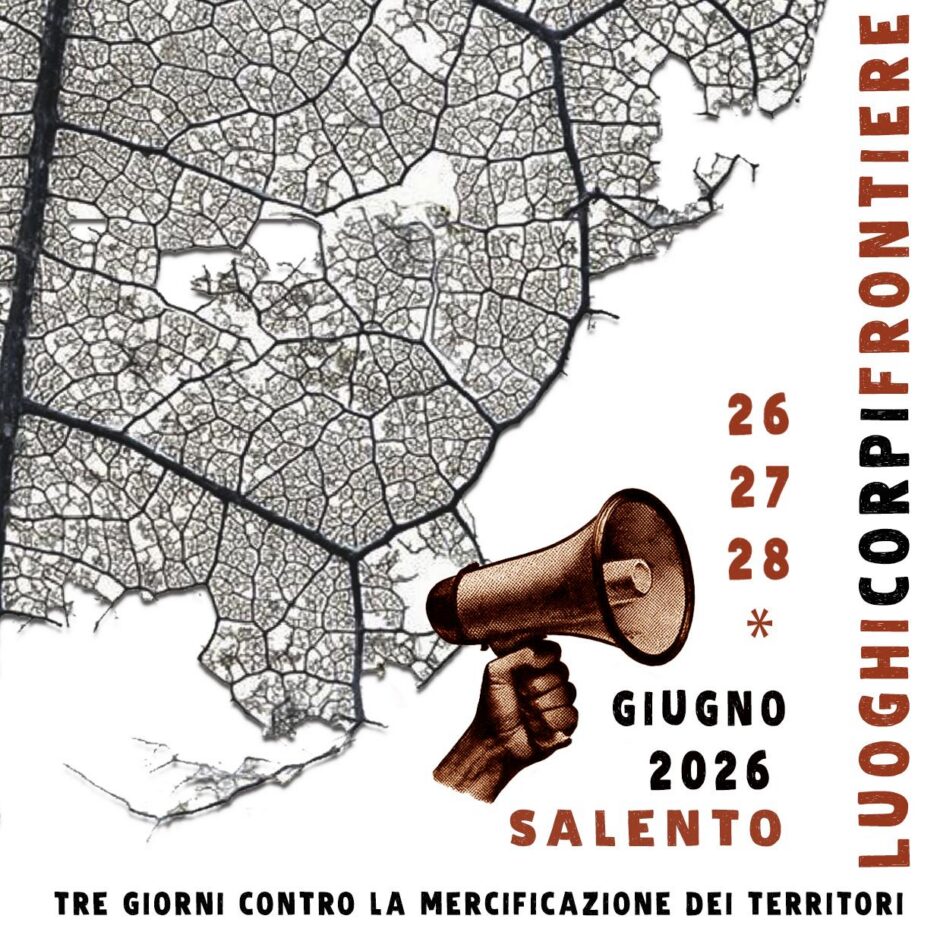
The place hosting us, the Terra d’Arneo, bears deep marks that speak of the relationship between human labor and the land. Here, in the early 1950s, farmworkers with no property decided to reclaim what they believed was rightfully theirs: the land belongs to those who work it! The occupations of the large estates gave shape to an idea of labor dignity finally freed from the parasitism of the landowners.
Later, when peasants traded these fields for the blue overalls of the factories, vast areas of this land came under the ownership of FIAT, which built a testing track for cars here. The track is now owned by Porsche. A new master, a modern high-tech image, yet the same old colonialist plan.
curated by some comrades from the journal “Il Movente”, Sicily
We will try to outline the characteristics of the Sicilian peasant movement, a land of “absolute beauty and absolute violence”, from the Fasci dei lavoratori to the land occupations of the post Second World War period. Here too, the ‘historic compromise’ between the left-wing government and the ruling class was achieved through the dismantling of a peasant movement described by Togliatti’s rhetoric – and Marxist rhetoric in general – as counter-revolutionary. The so-called Italian economic miracle, far from being a prodigious event, was made possible by the exploitation of Southern labor who had migrated to the industrial centres of Northern Italy and of Europe.
curated by some comrades from the “Campagne in lotta” network
Following the thread of migration, we arrive at the present day, when—along reversed flow—the places we live in are populated by female and male workers from other Global Souths. We ask ourselves to what extent, and indeed whether, these realities are “other” from us, and to what extent they are instead part of a shared history, as old as the relationship between human labor and the land. We consider how the presence of migrants over the past decades has taken shape in the South, between subsistence, resistance and struggle against the violence of the State and of the third sector—an hybrid entity that functions in the alignment between institutions, market and democratic decorum. While the old cliques of big landowning elites have modernised, transforming themselves into present-day large-scale retail organisations, nothing has changed regarding the predatory aims inherent in the same logic of profit. Even today, we see struggle as the only possible real response. Struggles that must necessarily aim to decolonize territories and people, in order to truly overturn the dynamics of control and power.